

SEPTEMBER 15, 2026 FATHER PETER TURRONE
“A sword will pierce your own soul too.”
Today we celebrate the Memorial of Our Lady of Sorrows. So, what is sorrow? It’s an intense inner pain, or an agony. I can be experienced for different reasons. It can be experienced because of seeing someone else suffering. It can be because of being the recipient, right, a victim of evil. Or it can also be a consequence of having sinned. And then when the Lord breaks through the conscience, then there’s this deep regret, this pain, inner pain that we feel.
In the case of the Virgin Mary, there’s no sin, she’s sinless. So this is not how she suffers. Her sorrow comes from the fact that she is seeing her Son, love incarnate, in agony. This sorrow that Mary feels in her heart, we know, culminates with Jesus on the cross. And John describes this painfully and beautifully when Mary is there at the foot of the cross, when Jesus dies. But we know from today’s reading, the Gospel reading, that this sorrow that Our Lady feels is something that was with her her whole life. So there was joy intermingled with sorrow.
How is that? Well, Luke tells us that the Virgin Mary and Saint Joseph, they walked in, obedience to God’s laws, they go into the temple, and they present Jesus. So, there’s this anticipation, there’s this great joy, right, for bringing the first born, bringing Christ into the temple. And you hear many things, but then she hears that Jesus is destined for the falling and rising of many in Israel. So when Gabriel appears to her, he says Jesus is going to save his people. Right, he is God with us. So now she finds out more as to how that’s actually going to take place. And then once he says all of this, he goes on, and he says: “The sword will pierce your own soul too.”
A lot of the anxiety that we can experience, or pain that we can experience, rather, pain, is something that has to do with the present. But the Virgin Mary, her pain, and her anxiety that she has, is not just with the present, but now it’s also anticipatory anxiety. Because inside of her heart she knows that her Son, this beautiful little baby she’s holding in her arms, is going to be the recipient of profound evil. And the target of hatred. He’s come to save us from our sins, but not everyone will accept salvation and repentance.
The Virgin Mary, she participates, right? The Lord is the sole redeemer. It is Jesus’ suffering, and Christ’s alone, which saves all of us. Christ is the sole mediator between God and man. The Virgin Mary participates in this suffering. By seeing her beloved Son, who is love itself, and because she loves Jesus so much that she feels the pain also, as a mother does. So and this is something that causes her profound sorrow, by participating in all of this, by witnessing her Son.
This is just an example. You have a mother, she’s in the hospital, and she’s looking at her son, her child. And her son is very sick. This just happened a few weeks ago. I got a phone call, and it was one of our beloved parishioners who got into a really bad accident. So I went to the hospital, and I was really nervous, because I thought, “I don’t know what I’m going to find when I get there.” So when I get there, I see him, and I see the young man, and his dad was there. And I looked at the dad, and the dad had this look, because he loves his son so deeply, had this anguish in his face. Then a few days later, I saw Mom as well.
I’m looking at this wonderful young man, who is on the mend, thank God, but also seeing the mother and the father with so much pain. Again, they are not in the hospital bed, but their love for their child is what binds them. So they feel this agony. And there are many mothers and fathers, and many people who love others who suffer as a consequence. Right, we suffer seeing what other people are going through. So, this is the Virgin Mary. She experiences this.
There’s a great painting from Liz Lemon Swindle. She’s a contemporary artist. And I remember seeing this a little while ago. She did one on the Magi, and I had preached about that during the Feast of the Magi. And it’s called “Be It Unto Me.” You see the Virgin Mary holding baby Jesus. You see baby Jesus, he’s adorable, and then you see Our Lady, so beautiful, so pure, and you see hope, but you also see fear in her eyes. And a mother, a father, can understand that. Because you have this joy of seeing of the love that you have, but then also this anxiety about the unknown and the future. So, mothers and fathers can understand this.
And the reason why we focus on Mary, our Beloved Mother, on this particular feast day, is because we join her, we stand by her, as John did at the cross, and we are there to be with our Mother. And it’s not so much that we’re there to be next to her, but it’s more that she can be next to us. So, Mary’s strength, her love, is perfect. Her faith is perfect. Her hope is perfect. Her love for God is perfect. And therefore, by being close to Mary, by being next to her, she teaches us how to suffer. Because suffering is not good. Who wants to suffer? Nobody wants to suffer.
Jesus himself, as we heard in the first reading, from the letter to the Hebrews, it says Jesus, who is God in the flesh, suffered. And he was crying out to the Father, because of the pain that he was going to endure and in anticipation, he knew what was going to happen to him. And this caused him to sweat blood when he was in the garden. But Jesus, who is God, who has his mission, is firmly focused on fulfilling the will of the Father, allows him to be able to do what is necessary. Our Lady, the Blessed Virgin, she does the same.
Jesus keeps his eyes firmly on the Father, and he looks at Mary from the cross. The Virgin Mary, she looks completely and totally immersed in Christ. And she’s gaining all of her strength in him. And there is this reciprocal, this mutual love, that flows between them. But her purity and her faith in her Son, knowing that ultimately, that everything will end not with Good Friday, but will end with Easter Sunday. With the resurrection. And that’s what allows Mary to be the only light left on the earth, you know, when Christ dies. Because she is the one that’s there carrying everything. And she understands what it’s like to suffer. Even though she is the theotokos, without sin, her suffering is real.
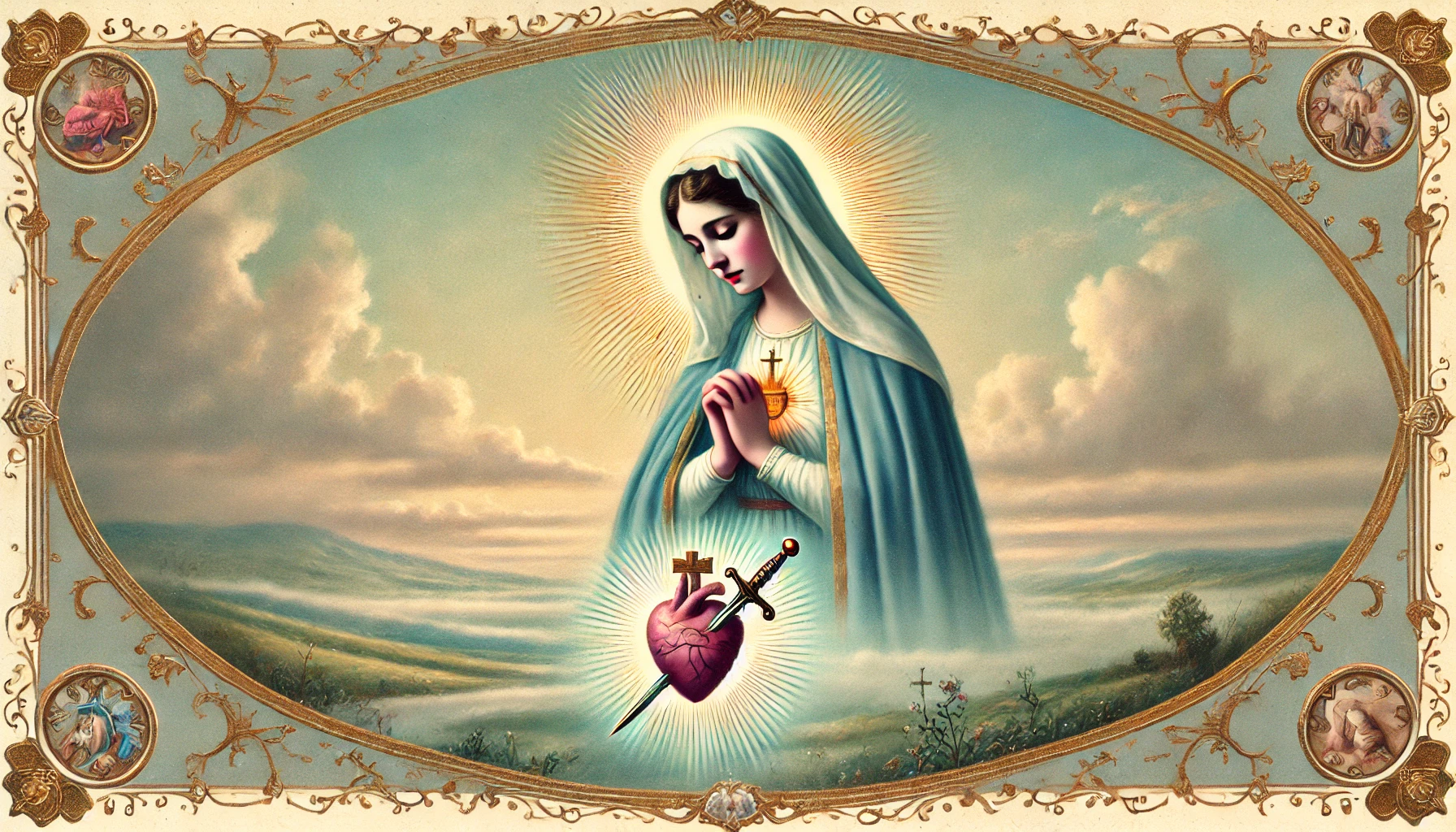
And this is why, when you go around the world, and you see all these beautiful artistic representations of the Virgin Mary, sometimes you can walk by, and you see statues, and there’s the different swords in Mary’s heart. You can see that, and then you can walk by, and maybe at that time you don’t understand it. But I’ll tell you, I’ve met many women, and many men, who understand that. They’ve loved someone, and they’ve seen them suffer, and they’re standing by and they can’t really do anything. You know, you can’t take their place, but you see them there, but you can be with them, in silence, and having compassion.
Mary’s love for her Son is by just being present to him. He’s the one that gives her strength, and she also gives him strength. And by focusing on Mary and turning to our Mother, and asking her to help us throughout our sufferings that we have, the Virgin Mary is always there to console us. So there’s that beautiful devotion of consecrating one’s life to God through Mary, by being placed, you know, within her immaculate heart. Her pierced immaculate heart and her mantle. She teaches us like how to suffer, but how to rejoice and how to have hope.
Because whatever we’re going through, whatever pain you’re going through in your life right now, wherever you are in the world, she was always pointing to Jesus. And, again, we have to remember, that whatever suffering we have is temporary. What matters in the end is that we get to heaven, and the Lord is there with our Lady, waiting for us. And I hope all of us will be there one day.