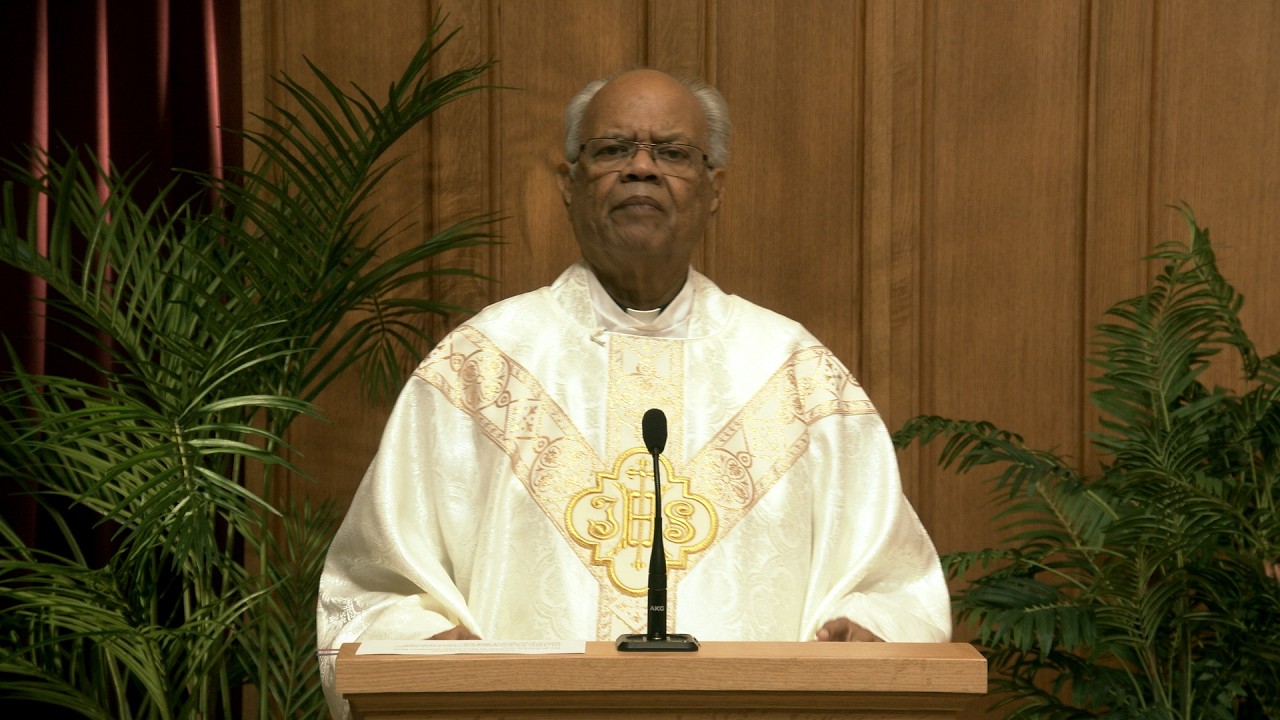


SEPTEMBER 16, 2026 MSGR. SAMUEL BIANCO
“What are they like?”
My brothers and sisters in Christ, I’d like to change this rather dramatically. I’d like to ask the question: “What is God like?” What we compare God to.
Our Gospel story tells us today something deeply. God is like Jesus when he’s in the marketplace, seeing what is going on in the marketplace.
As then, and perhaps now too, you go to a market place, it’s always busy. It’s filled with noise, with wonderful smells, with people moving back and forth, with haggling, with people carrying bushels, with people selling stuff, people talking, and families are gathering, they perhaps go off to eat, and be by themselves or be with other people. There’s a wonderful, if you would call it, creative chaos to a market, then, and perhaps now, at the same time.
And in the midst of this, all the young kids. The children get together and they form a circle, and they begin to play games in a variety of ways. And a group of them forms a circle, and plays a special game, where they begin to tease one another, and make music, and play all sorts of fun with one another. They’re having a delightful time.
Jesus is observing this. He’s observing all the things that go on among human beings, and the ordinary things of their life at the marketplace. And especially he sees and takes notice of the children.
It’s quite clear from everything we knew about Jesus, he loved children. He was enchanted by them. He took them into his arms, and he blessed them.
I think I could push this a little bit farther and say as a young child he probably did the same thing he observed in the marketplace. He danced and teased with other children. And I suspect as he was watching them dancing and singing, he would have loved to have jumped in, if it were possible as an adult, and joined with the circle, and them dancing.
God, in Jesus, sees the human condition in all its complexity, and he sees the beauty of children. He also sees, as Jesus saw, that children can be fickle. They can go from one side or to the other. They can tease one another. And they can change their mind. Things that from one moment mean something to them, at another moment it doesn’t hold true.
It’s a parable. If children can change their minds so easily, so, does Jesus observe, that we human beings can change our mind.
At one moment, we can be overwhelmed with the sense of our duty and our obligation, and in sorrow for our sins, and another moment, completely forget it. And one moment, we can praise the John the Baptists of the world, who are great moral teachers, and at other times, act as if they didn’t exist.
So, in that sense, we human beings are like children when they are fickle. When they can’t be counted on. When, in fact, they change their minds. And that tells us something about you and me.
Jesus sees that although there’s a goodness, there’s a certain inconstancy in all of us. That we’re quite capable of changing our minds and moving from strong moral positions to positions of condemning others, to sometimes being neutral, and not caring what’s going on.
And there’s a third observation I make, and I’m imposing the parable in a different way. We see the children dancing, and they’re having fun there, and they’re mocking one another. But the children are doing this in a marketplace where the adults are all around. And as all children do, they’re mimicking. They’re modelling themselves after what they see the adults doing.
In their dancing, and their changing of their minds, and their singing, and their music, what they’re doing is telling the adults, without preaching it, “Don’t you see that you’re like this too? That you adults are people who sometimes can’t be relied on. That you’re inconstant. That you’re not fair, and you’re not generous, even though you want to be, and try to be.”
The reality is the parable not only reflects on the children, it reflects on all of us.
The wonder of the story, the greatness of this, and I recognize I’m using the words in a broader way. Jesus doesn’t condemn. Jesus likes people. That’s too soft a word, I understand. But Jesus just likes people. He likes Pharisees, and hypocrites, and sinners, and those who are not very good, and people of all kinds and shapes.
Saint Paul expresses powerfully, Jesus is filled with a love that’s patient and kind and generous. And that’s the kind of liking that love that Jesus has. He sees all of us when we’re good, but especially he sees you and me when we’re hypocrites, when we condemn and judge other people wrongly, and pour out all sorts of bad views on people. We are the kind of people that Jesus wants to embrace and to receive.
In this marvellous story, Jesus does two things in his life. Jesus is very much like John the Baptist. He mourns and he weeps the evil, the destructive power in the society. He’s able to weep over Jerusalem, he weeps over Lazarus, he weeps over the children of Jerusalem. So he understands something of human pain and suffering, and he’s close to that, and he identifies with that. He pours his being into it.
At the same time, not “but,” but “and,” being someone who weeps, and mourns, and joins in human suffering, and wants to lift it up and raise it, Jesus is also the person who takes great delight in the human condition. In all of us, no matter what we do, or say, or our background.
If you will, Jesus is not only the person who can cry, and weep, and struggle, and try to bring people out of pain, he’s also the Jesus who, like David, is able to dance around the ark. Who at the wedding feast of Cana danced as children and as adults do with great joy and delight.
What is Jesus like? Jesus is like God. Or, more directly, Jesus is God.
When we want to compare God to something, the most perfect, the absolutely beautiful comparison, is if you see the way Jesus acts and talks and is, that’s the presence of God in our midst.
And so we weep with Jesus, we cry with Jesus. But also, we dance with joy and we sing, and we play, in this great world that God has given us, as part of our life and our being.