

OCTOBER 15, 2026 DEACON MIKE WALSH
There’s a story I like, and it’s told about this travelling evangelist back in the 1950s.
He arrived in this small town for what was called back then a tent revival. Now, it was his first time there, and early on the morning of the gathering, he left his hotel and he went to mail a letter. He had no idea where the post office was, so he stopped this young boy who was delivering newspapers. Yes, they still did that back then. And he asked him his name and if he knew how to get to the post office.
Well, the boy said his name was Bobby and he was happy to help, so he told the man, “Just go to the end of this street. Turn left, and look for the big oak tree.”
Well, the preacher was so impressed by the kindness of the paperboy that he gave him a flyer to that night’s meeting. And the revival was called Finding God in Heaven, and he invited Bobby to come.
Well, Bobby took a look at the handout and he gave it right back to him, and he said, “No thanks. I won’t be coming.”
Well, the preacher looked at the boy and he was a little astounded, and he asked him, “Well, why not?”
And without missing a beat, the boy looked at him and he said, “Listen, mister. How are you going to tell me how to find God in heaven when you don’t even know where the post office is?”
You see, finding our way to heaven is, for many of us, an overarching pursuit. And one of the ways that helps us in that pursuit, and one of the great blessings of being Catholic, is the Church’s dedication to the Communion of Saints.
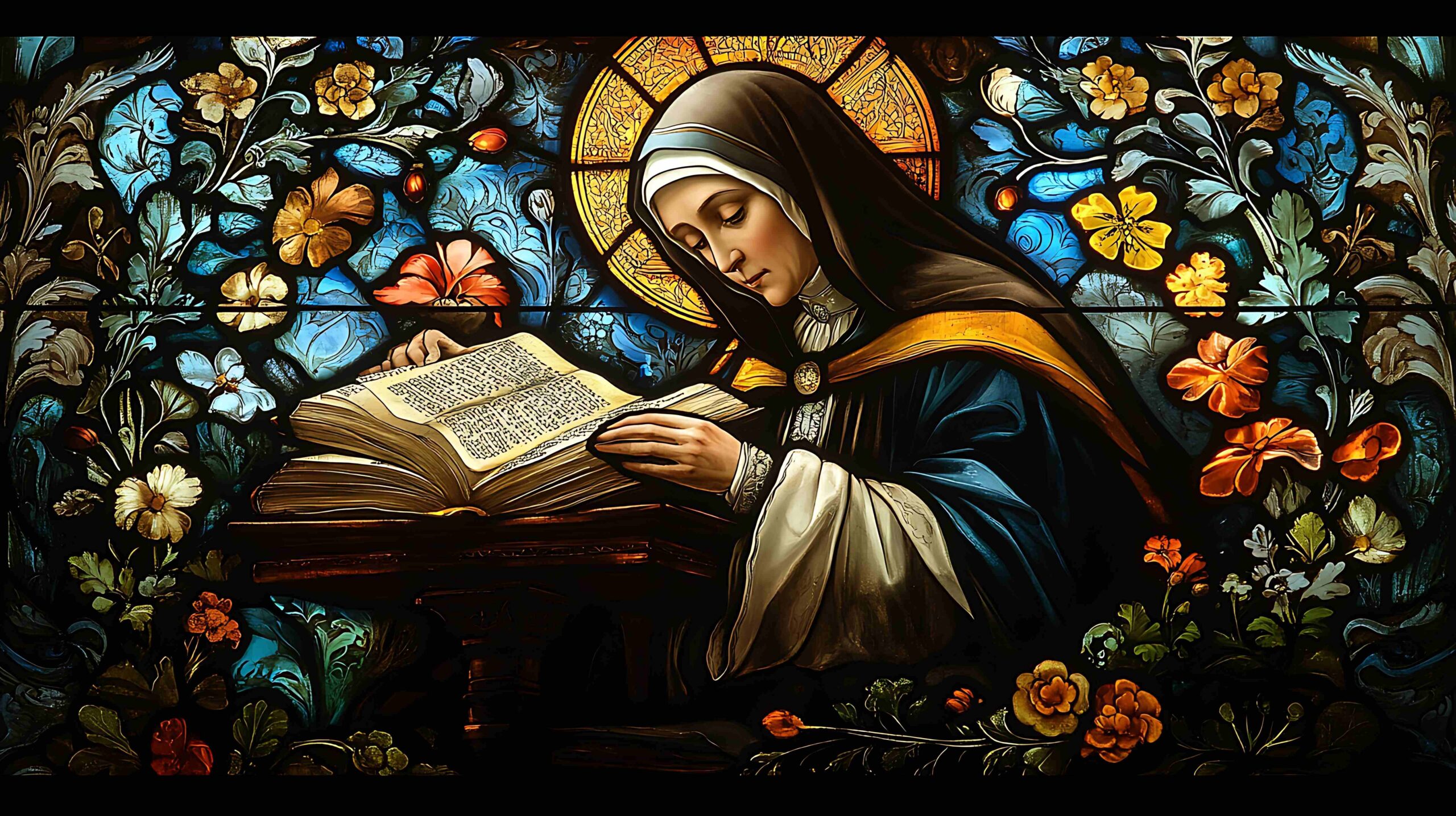
In a few weeks, on November 1st, we’re going to celebrate the Feast of All Saints, and after that, the Feast of All Souls, the true Communion of Saints. And today, we remember one great saint, St. Teresa of Jesus.
Now, that was her religious name, but many of us will know her as St. Teresa of Avila, the place where she was born.
She was only 20 years old when she entered the Carmelite Monastery of the Incarnation, and during her time at the monastery, she had a profound spiritual conversion after suffering through a grave illness.
According to accounts of her illness, Teresa endured severe pain throughout her body and many other symptoms. Her physicians reportedly considered her condition incurable, and she even entered into a four-day coma and experienced paralysis for more than two years.
In 1554, at the age of 39, Teresa of Avila began to pray before this image of the wounded Christ. This deepened and renewed her conversion, as she discovered what would become the foundation of her teachings.
Her spirituality centred on developing a personal friendship with Jesus through prayer, Scripture, the sacraments and contemplation. She described prayer as an intimate relationship with Christ, rather than merely the recitation of words. And this would become the central theme of her writings and her books.
Teresa died in 1582, was canonized in 1622, and then, remarkably, in 1970, Pope Paul VI proclaimed her a saint as a Doctor of the Church, making her the first of two women, along with St. Catherine of Siena, to receive the title.
In our Gospel today, Jesus is speaking to the leaders of the day, and he says to them, “Woe to all of you. Woe to you lawyers, for you have taken away the key of knowledge. You did not enter yourselves, and you hindered those who were entering.”
Now, this did not make Jesus any friends among the Pharisees and the scribes, as we are told that “they became very hostile towards him, and they cross-examined him about many things, lying in wait to catch him in something he might say.”
This passage finds Jesus challenging those in charge for closing the doors to the ordinary people; hiding the keys of knowledge. And to make matters worse, they didn’t even use the knowledge themselves. They simply prevented others from knowing it.
Teresa offers a very different example. She sought to enter more deeply into God’s truth and to help others discover the way to prayer. She’s very much about opening the doors of faith so that all may enter.
Her writings, especially The Interior Castle, The Way of Perfection and The Life, show us that. It shows us many things. That God dwells, first of all, within our soul. That we are the beloved children of a loving God.
In Ephesians today, St. Paul tells us that God destined us for adoption as his children through Jesus Christ. Teresa tells us that prayer requires perseverance, even when it feels dry or difficult.
The Daily TV Mass community is, above all things, a community of prayer. Day after day, thousands of you, thousands of people from around the world, unite in this sacred devotion, praying for God’s grace.
We pray for our special intentions and for one another. We pray for those who are unable to pray for themselves. We pray for those that we love and for one another. This shared expression of prayer is really a prayer of perseverance in faith.
Teresa also teaches us that union with God must produce love and service. And we are called to live in kinship with others, especially the least of our brothers and sisters.
So, following this example of Teresa of Jesus, the humble nun from Avila, may we grow in prayer, deepen our friendship with our Saviour, and go out into the world in peace, glorifying the Lord by the way we choose to live our lives.
God bless.