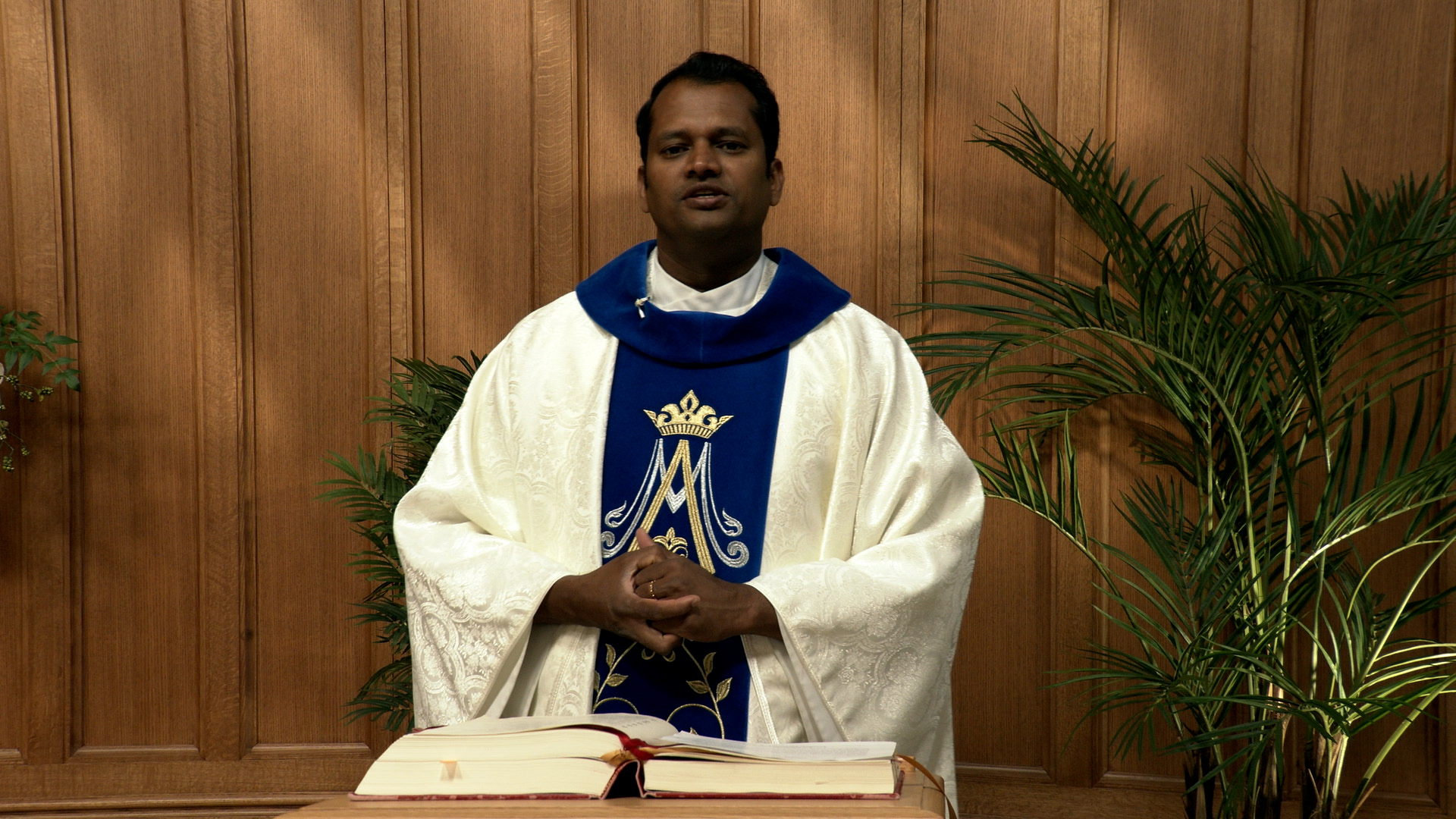


OCTOBER 12, 2026 FATHER VIJAI AMIRTHARAJ
A visiting preacher in a small country church delivered a 40-minute sermon on gratitude. And at the conclusion of the sermon, he said, “Remember, however small the gift, always be grateful to the Lord.”
And later, when the time came for the collection, an usher used the preacher’s hat to take up the love offering from the congregation. When the hat came back to the preacher, the preacher shook it carefully, but heard no sound. Then, he turned it upside down, but nothing came out. It was completely empty.
Seeing this, every eye in the congregation watched to see if the preacher would practice what he had just preached. The minister raised his hands to heaven, and still holding his empty hat, and he said, “Thank you, Lord, at least I got my hat back.”
Sisters and brothers, as we heard in the beginning of this Eucharist, today, here in Canada, we celebrate Thanksgiving.
I am confident, in most cultures, if not all cultures, have a day or a festival to give thanks, to celebrate the gifts and blessings of God and the many blessings we receive from those around us.
A little more than a month ago, on the first Saturday of September, the first reading was from St. Paul’s Letter to the Corinthians, chapter 4, where St. Paul would reprimand the Corinthian community by a simple yet powerful question: “What do you have that you did not receive?”
Now, those words struck with me. Not only did they stuck with me, but also, to some extent, bothered me. Because the honest answer to the question, “What do I have that I did not receive?” is nothing.
Everything is a gift, a blessing from God. But the fact is, I take things for granted. Most of us take the blessings for granted. And that, unfortunately, leads many of us, eventually, to a sense of entitlement, which is growing in our world, whether in family life or in religious life.
It is said that there are two fundamental ways of being and living in our world. One assumes that my life and everything that fills my life is simply what I am, more or less, entitled to. Another way assumes that my life and all that fills my life is simply a gift from God.
That is a very important dialogue of prayer that happens in every Mass we celebrate, just before what we call the preface that concludes with the “Holy, Holy”.
The priest prays that the Lord be with the community, the congregation present for the celebration. And the people pray that God will be in a special way with the priest who is ordained to do God’s will. And then the priest commands the people of God to lift up their hearts, to lift up their desires, and to lift up their lives to God. And the people respond, they have, in fact, lifted them up to the Lord.
And then, finally, the priest says, “Let us give thanks to the Lord our God.” And the people respond, “It is right and just.” And the priest then echoes that sentiment, saying, “It is right and just, our duty and our salvation, always and everywhere to give you thanks, Lord, Holy Father, Almighty and Eternal God.”
To give thanks always and everywhere is the right thing to do, whether we are perfectly healthy or have health challenges, whether we receive what we ask for or we don’t receive what we ask for, whether we celebrate a baptism or celebrate the funeral of a loved one.
In today’s first reading, St. Paul says, “Be thankful.” And in his First Letter to the Thessalonians, St. Paul would say, “In everything, give thanks, for that is the will of God.”
And in our Gospel reading today, our Lord Jesus invites us to ask, to search, and to knock.
And so, as we come together to give thanks on this Thanksgiving Day, let us pray for ourselves and for the entire human family, that we may always be blessed with an attitude of gratitude for the blessings of God and for the blessings of others in our lives.