

APRIL 30, 2026 FATHER HENK VAN MEIJEL
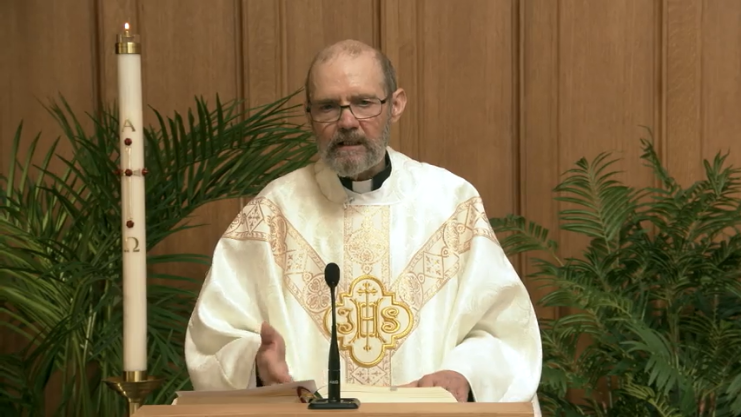
In this gospel reading, there is a whole lot of stuff we can talk about, and especially right after the washing of the feet. And the washing of the feet is, again, an indication that we are just servants. And this is, I think, especially for priests, for people like me, who are in the limelight and who are getting often too much attention. And to know that we are just mere servants. That we are not called to a life of privilege, we are just servants, and to keep that in mind always.
And also, Jesus talks about who, is going to betray him, but he does not mention a name yet, but we know who it is. And Jesus missions the apostles, and very truly, I tell you, whoever receives one whom I sent receives me,” it’s a missioning of the apostles. But the apostles don’t know yet, until after the resurrection, what these words really meant, how they were missioned.
And in the first reading of Acts, we have Paul, who also was missioned, who was personally called by God on the road to Damascus and chosen to evangelize and to meet the people where they are at. It is so important to know who we’re preaching at. Who we are dealing with. And so Paul, he is in Antioch and Pisidia, which is right in the centre of Turkey, not the Antioch where we often hear about which is right on the—on the east coast of the Mediterranean. But he meets the people where they are at. He is going to the Jewish community and he preaches about the salvation history starting in Egypt, and explaining how Jesus is a logical continuation of their history. And to put it in context for them. If he preaches to gentiles, it would be a little bit different but he meets this congregation and meets them where they’re at. And so the congregation can understand.
Today’s saint, Saint Marie of the Incarnation, isn’t different. Of course, she lived about 1,500 years later. She was born in 1599, died in 1672, and she was sent to Quebec City in Canada, and this was just a frontier town, maybe 10 houses or whatever. And a filthy mess. A real frontier town. And she was sent.
And actually she is a very interesting person, because she had, very early on in her life, she had visions already, and at age seven, she had a vision that Jesus asked her to join, to belong to Jesus. And she said yes. Her parents married her off, a different world than today. She was married off and in two years, her husband died, and she had a son, Claude, and she was left as a widow. But God kept calling, God kept calling.
And eventually, in 1631, she entered the Ursuline Order in France, and and she put her son in the care of her family, which was very traumatic for the son. The son even at one point tried to, with some friends, take over the monastery and rescue her, his mother. But it did not work. But she kept having visions, and it became clear, with the help of her spiritual director, that she was called to the frontiers of Canada, and this messy place.
And so she went, 1639, she left for Quebec City. An incredible hardship. Her house, with a few others, the house they were in got burned down, they had to rebuild. But she again met her congregation where they were at. And so she opened a school, and also in opening the school, the school was available for Native girls too, and to teach them the faith, and where there was a great need. And so she laboured for 32 years in that frontier town. Incredible hardship. Incredible hardship.
But of course, by the grace of God, God always gives the courage. And she persevered. And it is said that in the 32 years she was here in Quebec City, she wrote over 8,000 letters to France. 8,000. Unbelievable. Basically one a day, almost. And mainly to her son, her son who eventually became a Benedictine monk. And there was a great communication between the two of them, and no doubt, her son eventually understood why God called her, called his mother to the frontier town.
But an incredible example of someone really following God no matter what the cost. She was a servant, and she was sent as in the gospel reading, she was sent by God to make a difference in the world for so many others.
And this is, of course, our call, too. None of us are sent to frontier towns. We are also living 300 years, 400 years later, and we have it pretty comfortable in our contemporary world. But nevertheless, God continues to call. God continues to call for people to help out in the Middle East, in Sudan, or wherever there is hardship. And there’s people who answer those calls. Of course, we never hear about those people in the news because the news is only about bad news. You never hear about the good news. The good some people do in the world, and there is plenty of good news in the world. Amen.