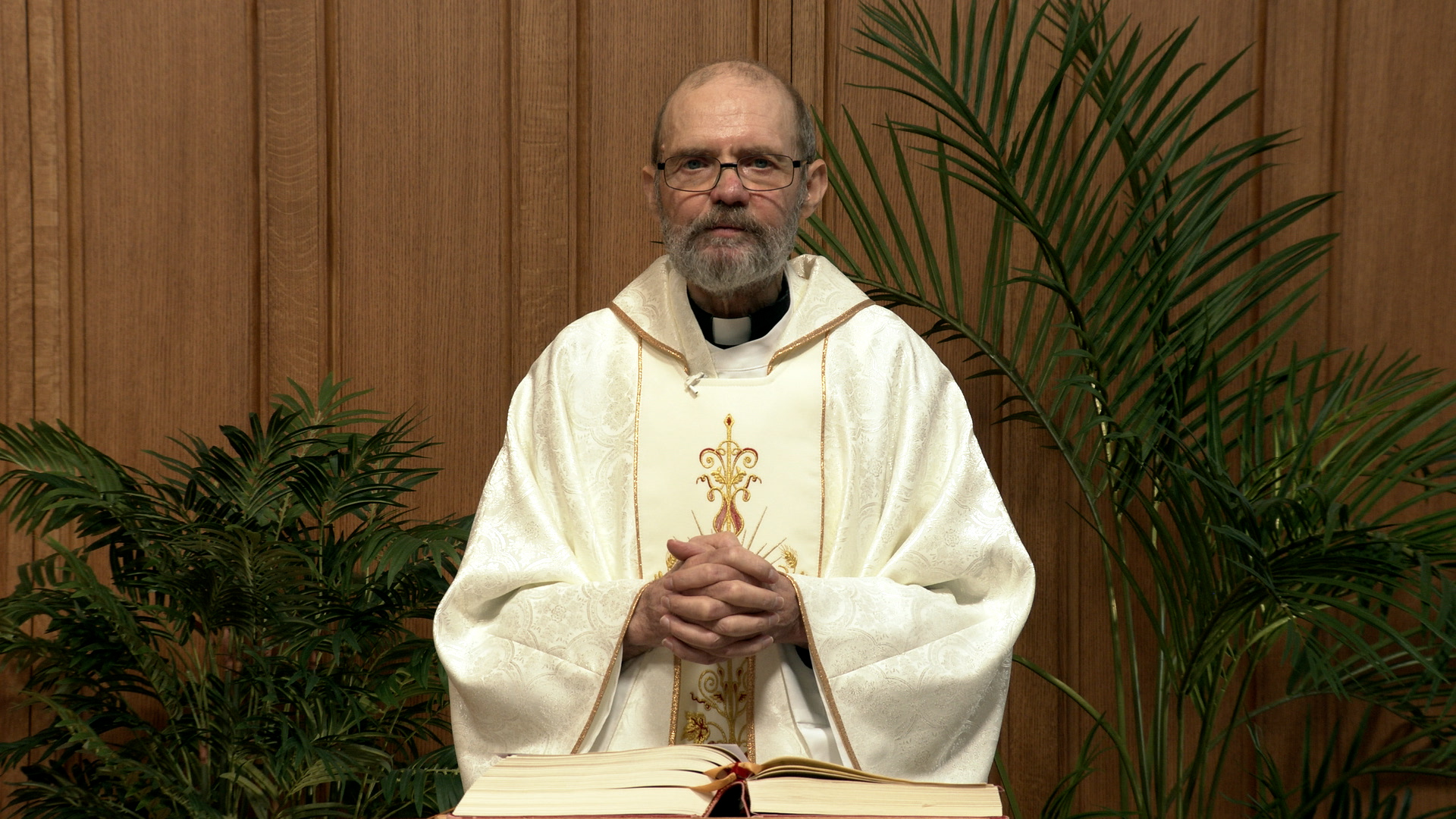


MAY 7, 2026 FATHER HENK VAN MEIJEL
It’s a very short gospel reading, and it’s actually so simple. And on the other hand, it’s not that simple at all.
And Philip, before this gospel reading question, “show us the father and we will be satisfied. Show us.” And Jesus answers, “abide in my love,” and that love, it’s very simple. And when our hearts are really touched by God’s love, then it is not very hard work to live out.
And he says, “if you keep my commandments, you will abide in my love.” If you keep the commandments, and if we just have to do it to stay in the relationship, then yes, we still abide in his love, but it’s not a real, true, deep love. Love should come by itself, and it’s a little bit like in relationships.
A couple can be married and they’re just doing the thing just to keep the marriage together, but it’s not a merit of real love. There is a relationship, but it’s not a deep love. But in a deep love, it comes organic. We don’t have to work at it. It just comes naturally.
We don’t have to, quote, behave and to keep everyone happy. It is just something very natural. A love with God can be a little bit compared to a good marriage. If we adjust, if a couple is just married and there can be that deep love and it is really touching your heart and it goes very deep, you just don’t want to be anywhere else.
But when a marriage grows, it’s not as touchy feely. It grows in a deep, deep friendship. The one knows from the other one what is happening. That does not have to be much conversation. This is also with God on a spiritual journey.
God is the first mover. When God touches your heart, it can be very deep, and it literally bring us to tears. But as a relationship grows with God, it becomes a little quieter. It’s good and there’s a peace, just like in a good marriage.
There is a real peace, a deep peace between the couple. That’s the peace of Christ. When we grow in the spirit, and as we just over the years, there’s a real peace. But even though if there’s peace, that does not mean that there’s no misunderstandings or conflicts and so on.
There is a way of resolving this and mutual appreciation and understanding. And that really brings us also to our first reading at the Council of Jerusalem, and it was about the year 48, so about 15 years or so after the crucifixion of Jesus, where there are differences of understanding.
You have the Jewish Christian community who was very much in touch with the Old Testament and salvation history, and you have the Gentile community who is just new and who does not have that history and who are also culturally different.
The community comes together trying to find a middle ground. How are we going to be united in God, in that God who loves each one of us in our own unique way?
There is a quote in the first reading from the prophet Amos, who was about eight centuries before Christ and who talks about the renewal of the kingdom of David. Jesus, as we know, is really in the line of David. It’s interesting that they use his quote during the council.
But they come to that mutual understanding and mutual appreciation. It does not mean that there’s no deep discussions and misunderstandings, but they come to the decision that the Gentiles do not have to be circumcised, that they don’t have to follow the Mosaic Law, and stay away from improper sexual relationships and the offering of food to God’s, just very simple, to stay in that loving relationship.
It worked, obviously. And it was something that came out of the church at Antioch, where the early Christian Jewish community and you had a large Jewish diaspora there, and you had all these questions coming together, and it had to be worked out, and it had to be worked out by the apostles to have proper directions from higher up.
Just like today, we rely on our people in Rome, in the Vatican, to give us the reactions for a worldwide church which is so culturally diverse.
And so wherever we go in the church in the world, the mass will everywhere be the same, but there’s a great variation in how it is done, the different parts of the mass.
I know I’ve been, I had a privilege to be in Jamaica, in West Kingston. When I was there, an hour and a half, anything less than they’re not going to be satisfied. Culturally different. But we are united in one.
It’s so important that we keep talking and keep working it out. And this is also, of course, on a political scale where Christians are fighting Christians in the world, or Christians and Muslims fighting while we praise the same God.
It’s so important that we dialog and that we keep talking and that we don’t use missiles and bombs and whatever to force views or wills on others.
It is good stuff to pray with, especially in these times where there’s so much disturbance in the world, where there’s so much need for peace in the world. It comes back to the core of our faith. And we can have a good example in the Council of Jerusalem, where they really were looking for peace and where they came to a peaceful solution instead of a lot of infighting. Amen.