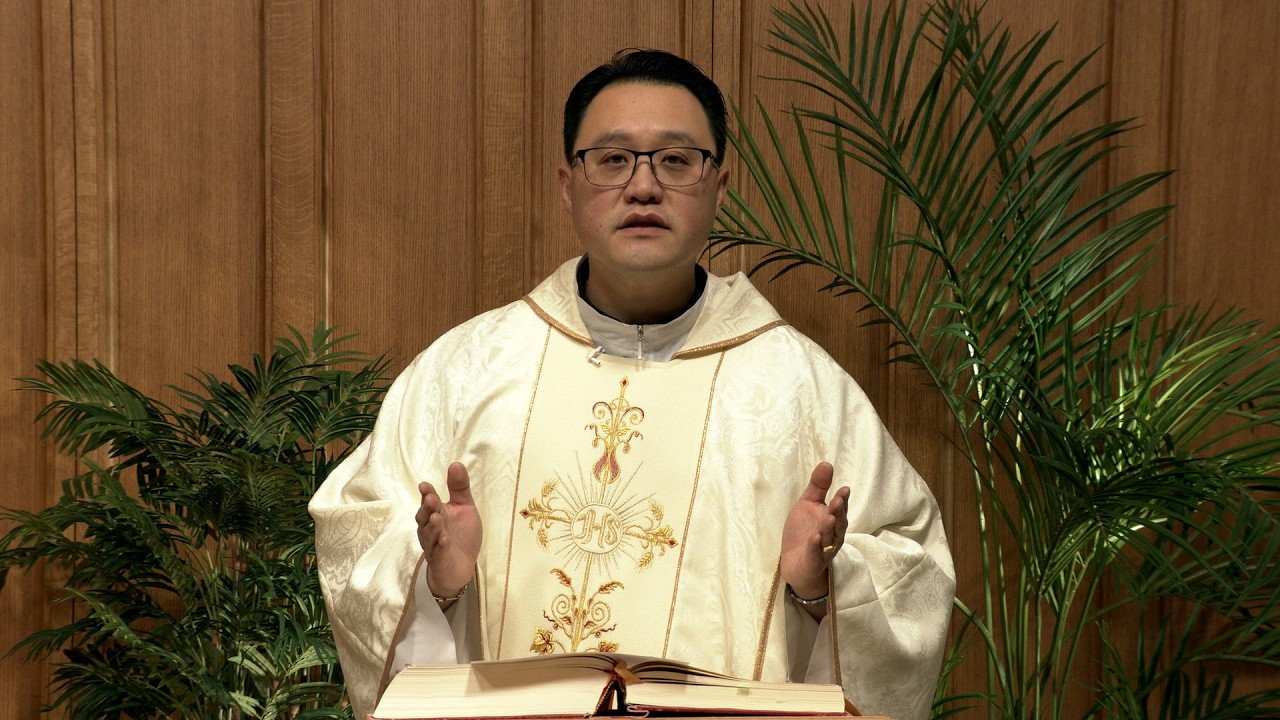


MAY 3 2026, FATHER PETER JAE CHOI
A rabbi once asked his students: “How do we know when the night has ended and the day has begun?” The students understood the importance of this question, as there are prayers and rituals that can only be done, some at night time and others during the day. So the first and brightest of the students offered his answer, “Rabbi, when I look out at the fields and I can distinguish between my field and the field of my neighbor, that’s when the night has ended and the day has begun.” Then a second student offered his answer, “Rabbi, when I look from the fields and I see a house, and I can tell that it’s my house and not the house of my neighbor, that’s when the night has ended and the day has begun.” A third student offered another answer: “Rabbi, when I see an animal in the distance, and I can tell what kind of animal it is, whether a cow or a horse or a sheep, that’s when the night has ended and the day has begun.” Then a fourth student offered yet another answer, “Rabbi, when I see a flower and I can make out the colors of the flower, whether they are red or yellow or blue, that’s when night has ended and day has begun.
Looking sad and disappointed with the answers, the rabbi finally interrupted them and said, “I don’t think any of you understood the question. You only divide! You divide your house from the house of your neighbor, your field from your neighbor’s field, you distinguish one kind of animal from another, you separate one color from all the others. Is that all we can do? Dividing, separating, splitting the world into pieces? Isn’t the world broken enough? Isn’t the world split into enough fragments?” One of the students asked, “Rabbi, please tell us. How do we know that night has ended and day has begun?” The rabbi replied with a gentle and yet firm tone of voice, “When you look into the face of the person who is beside you, and you can see that person is your brother or your sister, then finally the night has ended and the day has begun.”
Unfortunately, the world today has become so divided. When we do not love and forgive each other, we turn our neighbourhood, our workplaces and our homes, into unsafe and even dangerous places to be. Based on the first reading, the early Church’s missions were, firstly, to proclaim the Good News of salvation to the ends of the earth, and, secondly, to put faith into action and help those who were in need. But, the truth is morality cannot be legislated. That is why Jesus became one of us, not only to die for our sins but also to leave us an example of what we should do. Apostle James taught us that true Faith has to be backed up with our actions. Wishing someone well isn’t enough, we have to roll up our sleeves and help those who are desperately in need. Jesus taught us to love one another as He has loved us. Remember Jesus said “whatever you do to the least brothers and sisters of mine, you do it to me!”
Love without counting the cost, and give sacrificially. Many Christians through the centuries have tried to do exactly that. Especially during the medieval period, the Church built hospitals to take care of the sick. The Church built schools and universities, educating them in order to lift the people out of poverty. The Church has supported the widows, the orphans, and the needy when there was no government or social program to take care of those who were neglected. Even to our present day, Christians raise more money to help people throughout the whole world. Christian organizations feed more starving people than any other organizations, and whenever disaster strikes, Christians not only provide relief through donations, but they also take time off from their jobs to volunteer.
And this is what I learned while I was doing research for today’s homily. Who’s more likely to help those who are in need? The answer is Christians. But, not all Christians give equally. According to John Plake, the Chief Innovation Officer of American Bible Society, 87% of Christians, both Catholics and Protestants, who attend the Church at least once a month (and say their faith is very important in their lives) donate to church and non for profit organizations. The American Bible Society also found that going to Church and reading the Bible regularly makes people more generous. Not only are they more generous, but being generous actually makes them happier.
Obviously we have many problems in our society. And those problems won’t go away any time soon. What this means is the problems we have in our world today are the tasks God has given us. I came across a beautiful poem called “Who will Answer,” that I would like to share with you.
I asked our Lord to do something about the sick and the dying, those crippled with disease, and He asked me, “Will you comfort one?”
I asked our Lord to do something about the thousands who starve to death everyday and He asked me, “Will you feed one?”
I asked our Lord to love the people who seem so different from myself, and He asked me, “Will you love one?”
I asked our Lord to do something about those who have no rights to speak out for justice, and He asked me, “Will you speak for one?”
I asked our Lord to do something about the thousands of abandoned children in city streets, and He asked me, “will you protect one?”
In the streets and alleys, I saw children naked, hungry and cold. In my anger, I asked God, “Why do you allow such things? Why don’t you do something?” He replied, “I did something…I made you!”
As long as we see the world in the form of a division, we will continue to live in the dark. Daytime begins when we can see each other through the eyes of God who loves us. My prayer today is as Dorothy Day prayed, “Lord give us our bread to the hungry and hunger for you to those who have bread to eat.”