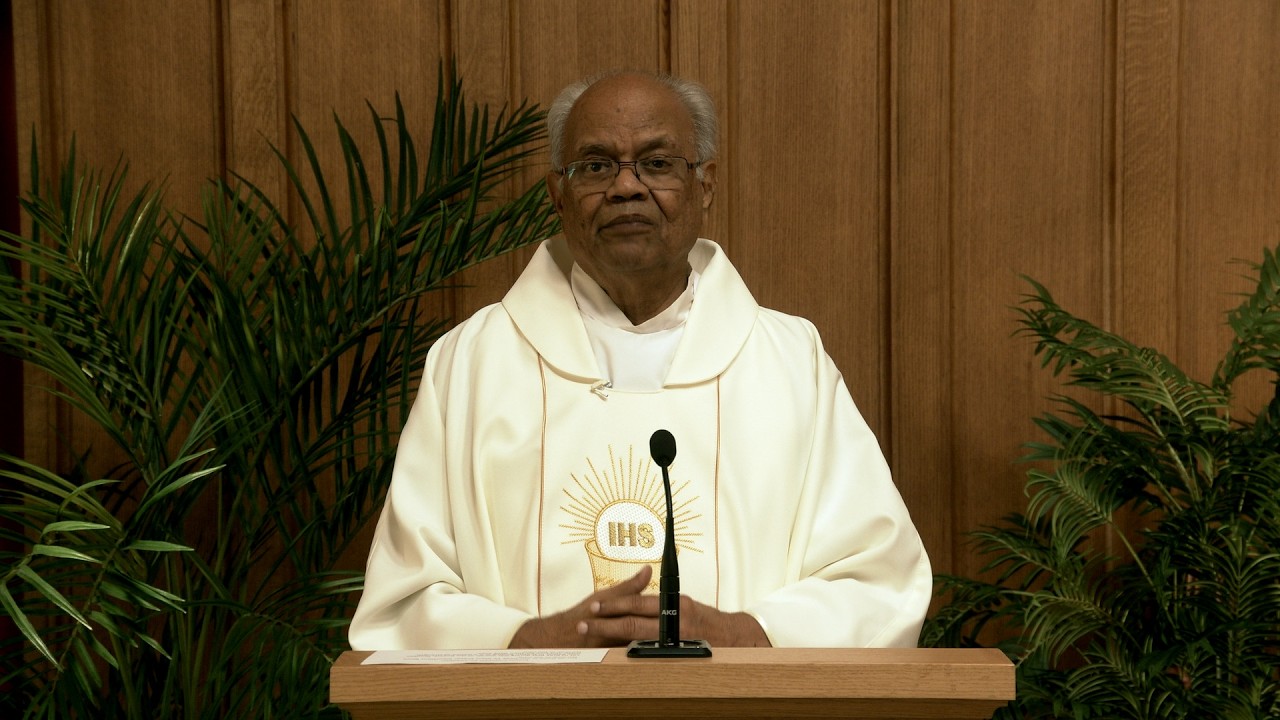


OCTOBER 30, 2026 FATHER MICHAEL COUTTS
Paul is, at present, under house arrest in Rome; the year is 62 Anno Domini, the year of the Lord. And his thoughts are about the churches that he had established in Ephesus, in Philippi, in Athens, in Corinth.
And the Letter to people at Philippi were very dear to him. And so, he kept on writing little notes here and there. And so, we have the Letter to the Philippians, just four chapters, but it’s a concatenation of different notes and pieces that he had written together.
Our reading today is just an introduction. He starts off with thanking them. It’s the same thing that you and I do. When we receive an email, when we receive a snail mail, or a text message, our first response is to say, “I thank you for the message that you have sent.”
The second thing that Paul does is he assures them of his prayers. Now, they knew that he was praying for them and they were praying for him. But it is important to tell people that you are praying for them and you are concerned about them.
I do that every time I write a letter to friends, whether they are believers or not, whether they are Catholics or not. You know what? In all the decades that I’ve written letters and said, “I’m praying for you,” not once did I get a message saying, “Don’t waste your time praying for me; I don’t believe in prayers.” Even people who never go to church or never have any sense of prayer, they are very grateful for prayers that are said for them.
And so, you have Paul’s Letter to the Philippians, the introduction. And finally, he prays for their intentions. Paul has got three things in his mind when he writes his letters. First, he thanks God for their faith. He tells the people of Philippi, “It is not because of your own goodness or your own qualities, or because you have merited, but God has been very gracious to you,” and he thanks God for them.
And he prays for their intentions just like you and I pray for the intentions in the intentions of the Mass. We pray for people who are sick, basically people who have had cancer, people who are taking care of people with Alzheimer’s or dementia, and things that really take and tax all our health.
But he also prays for harmony, a harmony of mind and heart among the people of Philippi. He knows that they are of different opinions and a different way of practicing their faith.
Now, in Philippi, the people are basically of Gentile background. There are a few Jewish-Christian believers with Jewish background; they never cause any problems. But at every place that he is in, whether it’s in Philippi, in Berea, in Athens, and in Thessalonica, there are always a group of very strong believers in the Jewish faith who do not accept Jesus, and they will always try to put objections and barriers to Paul’s preaching.
And Paul will tell the believers in Jesus Christ that, although you have people who insist that you have to have the Jewish background before you believe, he says it’s not very important. All you have to know is that you are embedded in Christ, for Christ, and by Christ and therefore, you are blessed.
But what I would suggest to you, that, if you want to read the Letter to the Philippians, the first thing to do is to go to chapter 2, verses 6 to 11, which speaks about the emptying of itself, or in Greek, ‘the kenosis’.
Jesus, though he was equal with God, did not consider this to be an equality, an advantage for himself. But rather, he took the form of a slave. He emptied himself, took the form of a slave, and pitched his tent among us. He became one like us in all things but sin. And because of that, every knee in heaven, on earth, and under the earth will bow to the name of Jesus.
Now, once you’ve got that message clearly and that background, the rest of the Letter to the Philippians gradually falls into place. One scripture scholar went even bold enough to say that, if every Bible in this world, every text in every language was destroyed, but we only had the Letter to the Philippians chapter 2, verses 6 to 11, we could build up the whole of our faith from there. It is Christ who was obedient to the Father, took the form of a slave, came among us, and worked our salvation.
Now, the message from the Philippians and the message from the Gospel are two different things altogether today, and so I won’t even try to make a link.
We find Jesus at a meal with the leader of the Pharisees. When you come to see it, the evangelists always put Jesus at a meal. It’s at a meal that Jesus will continue to preach and give the message of the kingdom of God.
The first meal we have, of course, is Cana, the miracle of the wedding feast at Cana. And at the end of it, we are told, “And they began to believe in him.”
Then you had Zacchaeus, who wanted to see Jesus so badly that he climbed a tree, and Jesus said to him, “Zacchaeus, come down; I am going to eat with you,” which was at the consternation of all the people around because how dare Jesus would go and eat with this tax collector.
And there was another tax collector, and this was Matthew. Jesus calls him, Matthew follows him, and Jesus will go and eat with him.
But there were also benign situations in which Jesus was very comfortable and relaxing at the meal with Martha and Mary, and there, Jesus gave the message, “Seek what is most important, the one thing that is necessary.”
And finally, the Last Supper, when Jesus gave us the Eucharist. And when he said, “Do this in memory of me,” he not only gave us the Eucharist, but he took those twelve apostles and he made them the priests to continue with the tradition.
And so, it is at the meal now Jesus heals this man with dropsy. Now, whenever Jesus does a miracle, he takes them apart, or he does it in front of everybody to show a message. Here, Jesus simply takes the man, takes him apart, heals him, and sends him away because the real message here is not the healing of the man with dropsy, but on how the people would observe the Sabbath.
Was it so important to look at small traditions that they had, 150 traditions, you cannot do this, you cannot do that, you’re allowed to do this, and you’re allowed to travel only so far, or is it more important to look after the needs of your brother and sister who is in trouble?
And so, as the result of this, Jesus says, “I am the Lord even of the Sabbath,” which means that the traditions that the scribes and Pharisees had about all the people around did not hold any water. What’s more important is to keep your mind, your heart, and your whole being open to the message of God within our midst.
God bless you all.