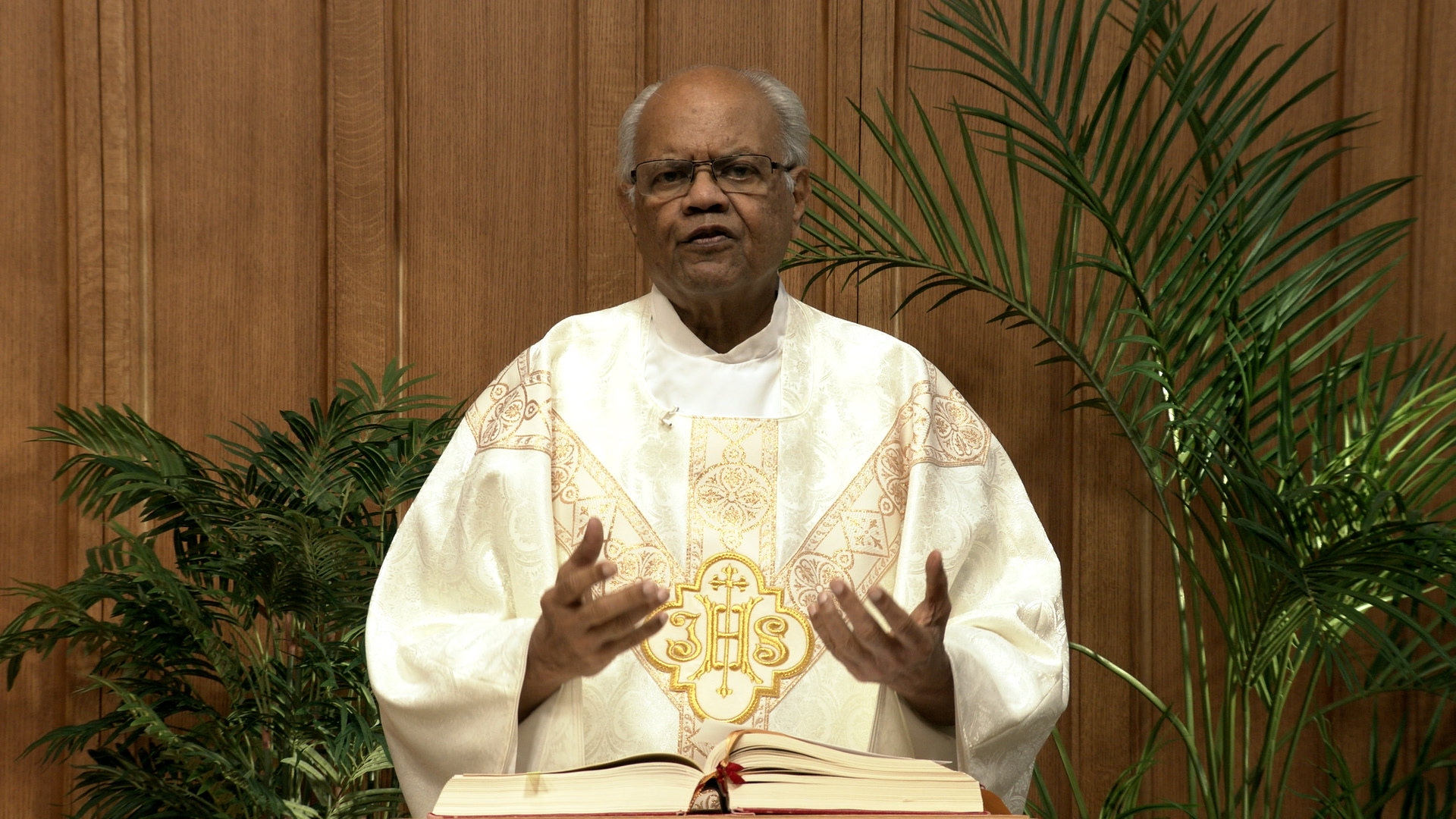


APRIL 17, 2026 FATHER MICHAEL COUTTS
Luke starts the third gospel with the words, “The good news of Jesus
Christ.”
In the second part of Luke’s work, the Acts of the Apostles, he shows
Jesus telling the apostles, “Go out to the whole world and proclaim the
good news.” And then Luke starts a paradigm or a structure by which he
will show how the good news was spread.
First of all, he always says they were led by the Spirit. The apostles
would go either to the temple, if they spoke in Jerusalem, or if they were
in the Gentile areas, to the agora or the marketplace.
They would proclaim the good news that salvation were for all. They
would be arrested and brought before the judge, who would find them
not guilty, who would find them free from any fault. They would then be
flogged, and they would be set free. This pattern appears several times in
the Acts of the Apostles.
The apostles were only following what Jesus himself had done. Namely,
he was brought before Pilate. Pilate says, “I find this man not guilty. I
will scourge him and set him free.”
Can you imagine this happening here in 2026 in our courts? The judge
acquits a man, and he says, “I find you not guilty, but before you go, I’m
going to hand you over to the policeman who will thrash you and then
set you free.” We would have a riot on our hands.
But this was not today. It was in the time of Jesus, in the time of the
apostles.
And we have here Gamaliel, who was a real character, a real person,
because he’s reported even by a secular historian called Josephus.
Josephus also tells us about the two events that Gamaliel will speak
about, the event of Theudas and his revolt, of Judas the Galilean and his
revolt.
And Paul would also say that Gamaliel was my teacher and rabbi under
whom I studied. So, Gamaliel was a very intelligent man and a man who
could bring a calming atmosphere, something that we need so badly
today in literally every country in the world.
Do you know, at this given moment, there are 51 countries at war within
themselves or with somebody else? Terrible indeed. We need people like
Gamaliel.
So, Gamaliel was there, who would bring a calming effect on the hot-
headed and the hot-blooded young Pharisees who wanted some results
immediately. And he said to them, “Wait a minute. If you’re going to
deal with these people who are illiterate, you will find that if they’re not
based on truth and justice, they will all disappear, just like Theudas and
Judas the Galilean. But if these illiterate fishermen are speaking about
something that they truly believe in, and it is based on God, you’re
fighting against God himself.”
Our problem here is how did Luke, two decades later remember the
speech of Gamaliel? There were no Globe and Mail. There was no
Toronto Star to report it. But the point was, because there was none of
these papers, this speech made such an impact that it was carried on in
oral tradition, more or less like Martin Luther King, “I Have a Dream,”
or in 1963, Kennedy says in Germany, “Ich bin ein Berliner.”
Those speeches remain with us, even though they are not written down.
And so, Gamaliel will bring peace and calm over the people.
And then, we come to Jesus, who multiplies the loaves and the fish,
Jesus, who shows that he is caring. It’s important to remember that
miracle of loaves and fish, but more important to remember Jesus who is
caring in our world today.
I have two friends of mine who have recently had strokes, one who is 86
and one who is not even 70. But their lives have changed, their wives,
their children, their grandchildren. The grandchildren are asking, “What
has happened to Grandpa? Why do we need all this? Is God angry with
us? Is God afraid that we have committed sin?”
It’s difficult to answer these questions. But when we hear of Jesus’
caring for the people at that time, Jesus still walks with us. Jesus gives
us the wisdom, the knowledge, and understanding.
And some of these wives that were speaking to me says, “Did we really
do this? Is it God punishing us?”
Way back in Guyana, in 1969, there was a song that was created, “Do
You Really Care?” I can’t remember who the author was, but those
words struck in my mind because they were so important for the turmoil
that was going on.
“How can you really care with fury everywhere? I cried, ‘God, where
are you? O where can you be?’ But I knew that after all was said and
done, that my God has loved me from beyond all time, and I will see his
face.”
These are the words that we can find in the Book of Job: “I know that
my Redeemer lives, and on the last day, I will see him again.”
It is this faith. It is not a cliché. It’s not a pie in the sky. It’s a reality of
people who believe, just like Kateri Tekakwitha, whose feast we
celebrate today.
God bless you all.