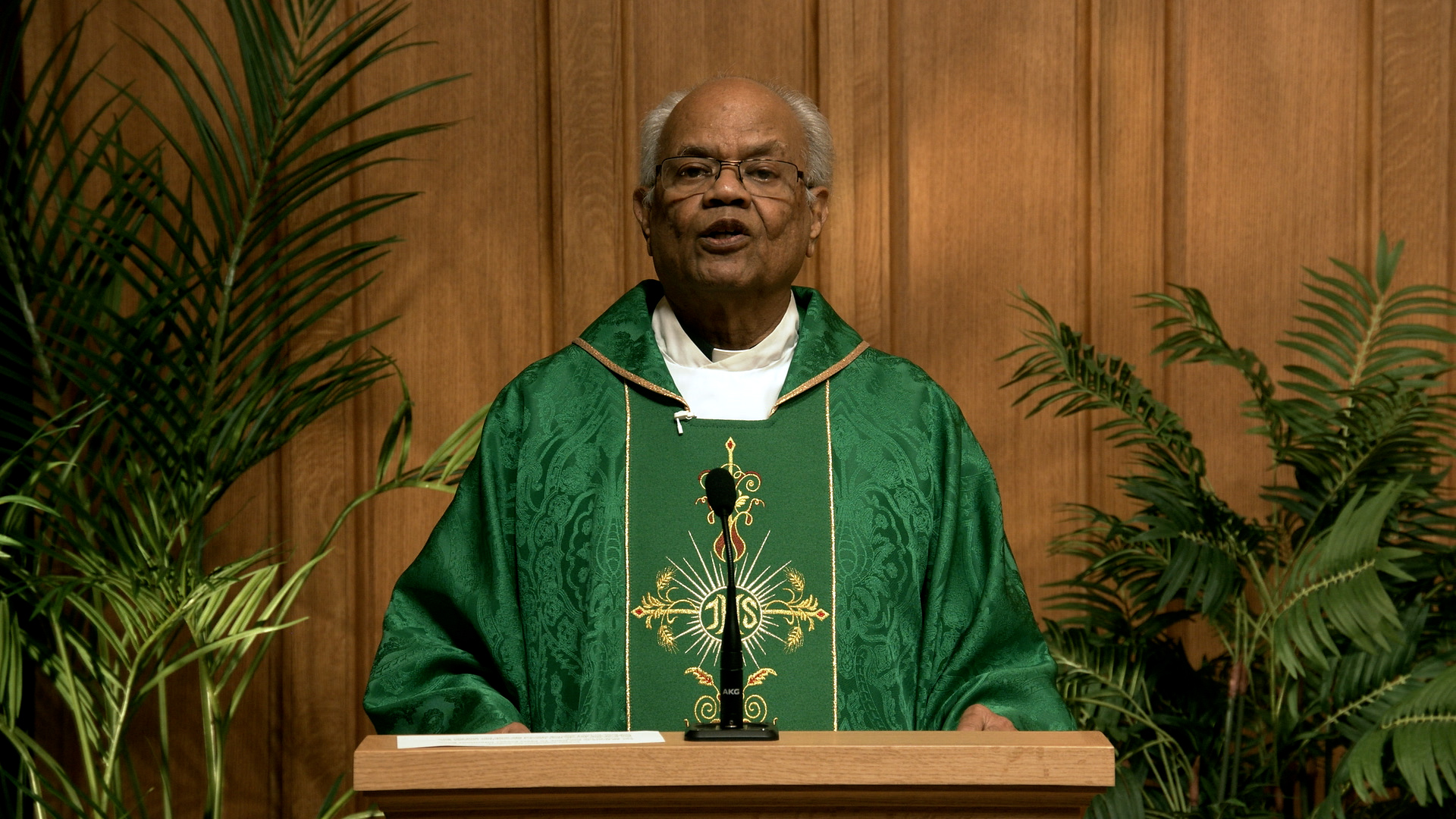


SEPTEMBER 5, 2026 FATHER HENK VAN MEIJEL
This short reading, Gospel reading, it almost sounds ridiculous. That the Pharisees tried to catch Jesus when the disciples were plucking some heads of grain. But, there’s much more to it.
It was deeply ingrained in Jewish culture that the Sabbath was holy. Very holy. And it really started with Jeremiah, or even before Jeremiah, in Ezekiel, but Jeremiah and Ezekiel, two prophets at the time of the exile into Babylon. They really emphasized that on the Sabbath you just do whatever you want, commerce goes on, and you just pretend there’s no God, and you just carry on.
Really, not much has changed in our culture. Sundays, about 40 years ago or so, when in Canada when they opened the stores on Sunday, Sunday has become a free-for-all. It’s really too bad. It should be a family day. We should not be running all over the place and doing all kinds of work. We should focus on the family. But I’m just a voice in the wilderness, so that won’t make a difference.
But it is good stuff to pray with. Am I keeping the Sabbath holy? Am I keeping Sunday holy? Am I only doing what is necessary on Sunday? A farmer will have to milk his cows, otherwise there’s going to be problems. But there’s lots of stuff being done on Sundays especially which is absolutely not necessary, which can be done also on another day or evening. It is something to really evaluate for each one of us. To know that it’s not all about money. That we all, that we all, human pride can get so easily in the way of human convenience.
In our first reading of Corinthians, we have Saint Paul really telling the Corinthians that everyone is equal, that we should not take advantage of one another. Not thinking that I’m better above everyone, and that I can do whatever I want to. Saint Paul really can get a little bit sarcastic. Basically, he tells them to smarten up. In quite a lengthy way.
But to know that God gave us great gifts. Great gifts, and that ties in with the Sundays. Sunday is the time of, the Sabbath is a time to sit and to realize how great, how blessed we are. It doesn’t matter what our possessions are. We are each blessed to be alive, and to be here. Not to think that I’m better than anyone else, or that I have a higher status than anyone else. Everyone is equal.
We have different responsibilities maybe, but just because I’m a priest would not make me any better than anyone else. It’s good stuff to pray with. I think a lot of abuse in society, even past abuse in the Church, comes from that, of thinking that someone is better than the other one, and that we can take advantage of one another. But we’re equal.
Today’s saint, Saint Teresa of Calcutta, very much knew that. Everyone is equal. That we have to look after one another. Saint Teresa of Calcutta, who died in 1997, and I very much remember her death. Everyone knew she was a saint already, way before she died. She was only canonized about 19 years after her death. Usually, it’s about 50 years or so before anything happens. But it was clear that she was a saint.
She received, as we know, that call within a call. She she was a Loreto Sister, teaching, she was headmistress at the school. But she was disturbed by what happened outside the school. Of course, it was a privileged school.. But she saw also what was happening on the streets in Calcutta. She was disturbed by that.
In 1946, when she went on retreat to Darjeeling, more northeastern India, to the retreat house of the Loreto Sisters, she literally received the well-documented call within a call. A call to serve the poor. Those who have nothing. She, it took some medical training, and she was relieved of her vows, as a Loreto Sister, and she started to live on the streets of Calcutta.
She knew that everyone was equal. Right across religious. They’re not, she was not going to say: “Hey! I’m Catholic, and if you’re not Catholic, you know I have nothing to do with you.” She really spent time with all those who were dying, no matter what. To Muslims they would read the Quran. For the Hindus they would get some water from the Ganges, especially when they were dying. The Catholics would get the last rites.
So everyone was, for her, equal, and she would meet people where they are. People where they are in their faith, and where they are, of course, socioeconomically. She made of course, an incredible impression, because, especially in Indian culture, those at the lowest end of the social ladder, they were nothing. You might as well call them dogs. They were just equal with dogs. But she brought that Christian compassion. That Christian compassion to make a difference, completely away from what’s happening in the Christian community, to look after everyone no matter where they are.
Of course, today we have, she started the missionary Sisters of Charity in 1950, and it grew over the years by leaps and bounds. We find them basically all over the world now, taking care of the poor. Those who are at the bottom end of the social ladder. Especially in inner cities.
I’ve had the privilege to be a few times with the missionary sisters, who also take a vow of poverty, and really try to live on the basic needs of human needs. But be there to live out the Christian life. The Christian life, which is not about me, it is about us. Giving it all to God in service of the poor. Amen.