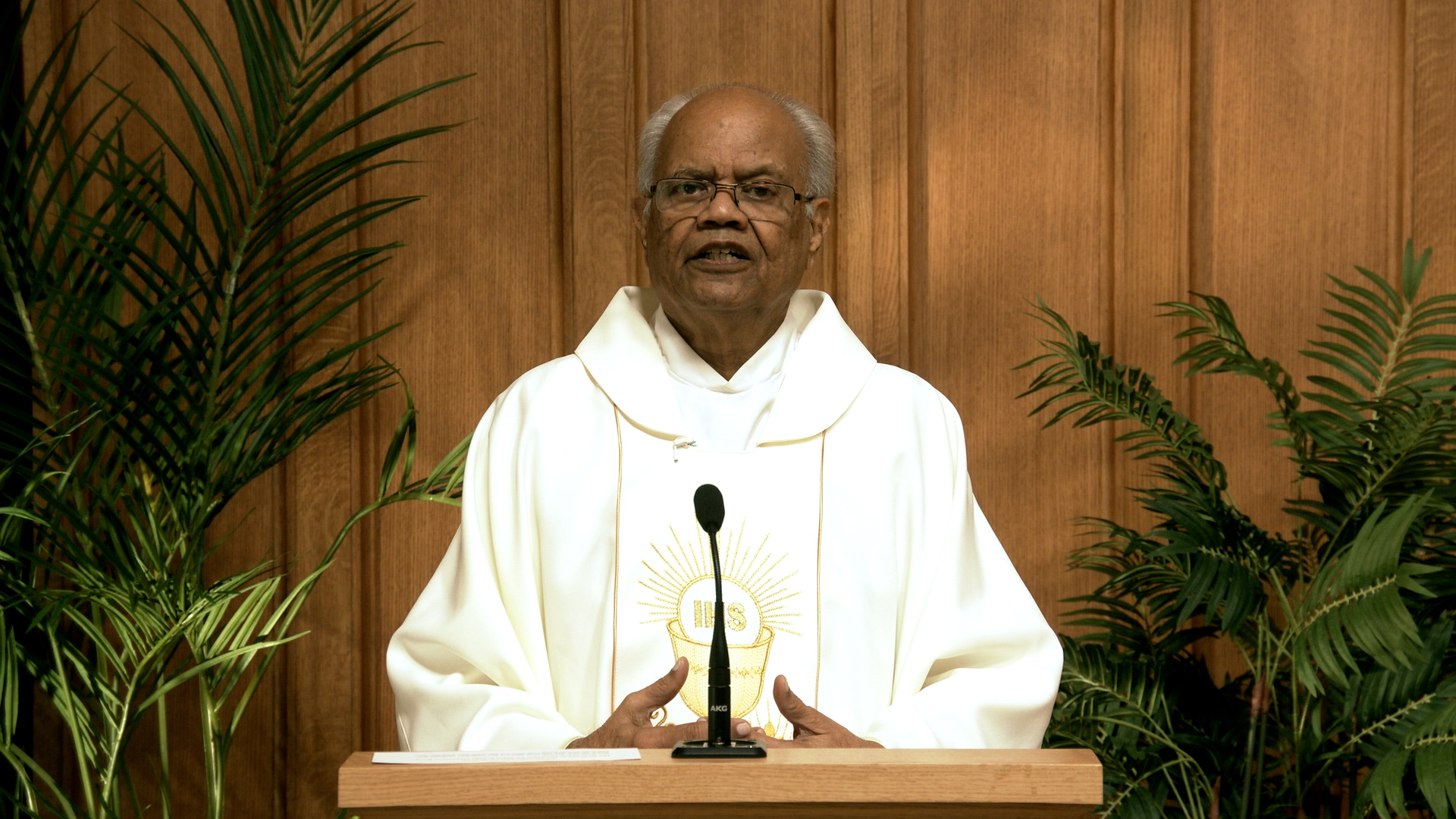


AUGUST 26, 2026 FATHER MICHAEL COUTTS
Our first reading is a conclusion of the second letter of Paul to the Thessalonians. And he writes these very strong words, “Anyone unwilling to work should not eat.” And I thought to myself, “This is a part of our reality.”
We are human beings. We are weak. We commit sins. We commit falls. We try to change our lifestyles. There are some who will tell what is called “white lies.” Others will help themselves to perhaps paperclips, or rubberbands, or pencils from the office. Others will be just lazy and won’t do any work.
So, why is Paul so very strong about this factor of our human life? Laziness is so common among so many of us, and you will find it all over the place. In our parishes, you’ll find somebody who’s lazy. In the CWL, in the Knights of Columbus, in the Saint Vincent de Paul Society, and even in our Jesuit community you’ll find some. They will talk, and talk, and talk, just to avoid work.
We had our infirmary here and I always marveled at one of the guys who used to serve us. He used to get engaged with all the Jesuits who were sitting down, asked them how they were, how they slept at night, But he never lifted a plate to take it back to the scullery, never brought another refill of coffee at any time. And I said, “Boy, he knows how to work the ground over here.”
So, why was Paul so very strict about it? “Because,” he said, “you cannot be lazy because you are a part of Jesus Christ.” You see, in the letter to the Thessalonians, there were many who decided “Well, the Kingdom of God is coming to an end, so, why bother to work?”
And the people who were lazy had some great faults among themselves. They had oodles of time to sow confusion and chaos in the community. They had oodles of time to spread gossip. They had oodles of time to give us the reasons why people acted. They couldn’t even know who the person was, but they gave the motives for any actions. And therefore, these were the people that started chaos in the community, and Paul was very strict about it.
And the reason, as I said before was because they thought, “Oh, the Kingdom of God is just going to come to an end. So, why should I start an enterprise? Why should I start a business? Why should I start a project? Because the world will come to an end. Why would I go and plow the fields? By the time the second coming of the Lord and judgment comes, there won’t be even time for the fruit to ripen.” And to take this to the ridiculous, “Why bother to make my bed in the morning because judgment may come in the afternoon?”
And so, we had all these people in Thessalonica who were sowing confusion and Paul was very strict about it. When he came to the first letter of the Thessalonians, Paul said, “These are the standards you and I have to keep in order that we may have peace, harmony, and a good way of life.” And he gave three beautiful pieces of advice.
He says, “First, live a quiet life. Don’t go into pomp and circumstance and try to get all the latest gadgets possible.” The second, he says, “Mind your own business. Don’t bother about what is on somebody else’s plate, because you’ve got a whole lot of problems on your own plate.” And the third, he says, “Put in an honest day’s work.”
And as I read this, I thought about all the people. And we mentioned the Catenacci and the Damiani family. When their ancestors came over here, what did they do? They worked very hard. They kept the law. They made sure that they would help others who were in problems and worries, but they did not interfere in somebody else’s business, because they respected their privacy as well.
I remember 50 years ago, I was working at a parish in the Grey-Bruce Peninsula, Mary Immaculate’s Parish in Chepstow. I never had to find where my car keys were, because they were in the ignition all the time. And the rule was, if you got caught in the evening somewhere, during winter, you could borrow somebody’s car, and you can be sure that it would be brought back the next day, and the tank full.
There was a certain amount of care for one another. And this is what Paul said with the Thessalonians. They were a church that were very close to Paul, which is quite different from our gospel today, where Jesus speaks to the scribes and the Pharisees, and it’s a continuation of chapter 23, and he speaks about two metaphors.
He says, “Woe to you scribes and Pharisees. You look like whitewashed sepulchres full of dead men’s bones.” Why did he use that phrase “whitewashed sepulchres”? If people were traveling in the night, and very often, they had to cross through a cemetery, they made sure that the tombs were whitewashed so they could be seen even in the dark.
To touch a tomb, or to touch a dead person, would leave them contaminated, would leave them defiled, and they would have to go into a quarantine for seven days before they could get back in to work. Jesus said, “You know, what you do is, your ancestors killed the prophets. You built great, great tombs for them. You ornamented them and you whitewashed them, but you can’t whitewash what you are doing now. Your hypocrisy is great.”
And the second metaphor, which was not in our gospel today, Jesus called them, “you brood of vipers.” These were the same terms that John the Baptist used when he was baptizing in the river Jordan. And anybody knows, a viper, a snake, is something that we can avoid. It is a cause of problems and worries. And even ordinary non-poisonous snakes, like the grass snakes, we avoid them because nobody likes to be close to snakes.
And yet, Jesus speaks about the scribes and Pharisees as being a “brood of vipers.” Not all of them were like that. They were basically good people. They kept the law. They kept the tradition. They taught their children. The only problem that they had was they became judge, jury, and executioner if somebody broke the law.
And that is why Jesus said, “You brood of vipers.” “Why don’t you just teach people, but leave the judgment to God?” A very good example, and a very good piece of advice to all of us today. God bless you all.